Extra - λ
Thanks to Chris Coombes for feedback on an earlier draft of this, and for doing so much with a much earlier presentation so as to inspire the work at all.
For today, we are going back to foundations -- some of the oldest, and most fundamental and fascinating ideas in the entire field of computer science.
To get there, we have to talk about a few people.
Act 1. The Logicians
The first, you may have heard of, Alan Turing.
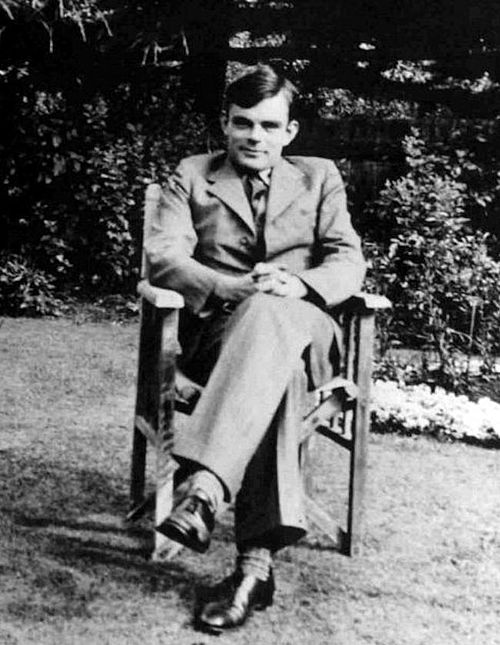
Turing was a mathematician and logician by training, and like many logicians around that time -- in the 1930s -- he was fascinated by the problem of how you express reasoning in mechanical ways.
In the present, we might call this programming, but remember, this is the 1930s -- there are no computers, so this was entirely on paper, on chalkboards, or described from person to person.
However, it was these people, and the discoveries that they made, that enabled the breakthroughs that allowed the first computers to be built. The ideas were needed first before the machines could be built! Today we'll rediscover some of those fundamental ideas.
Turing's accomplishments
Turing did many things -- he's famous for at least three that are worth mentioning --
- From the very beginning, he was fascinated by the idea of thinking machines. He devised a test for whether a machine was intelligent. He was also interested in chess, and designed a program to automatically play chess in 1948; the extremely early computers that existed at that point were not capable enough for it, so he never saw it run.
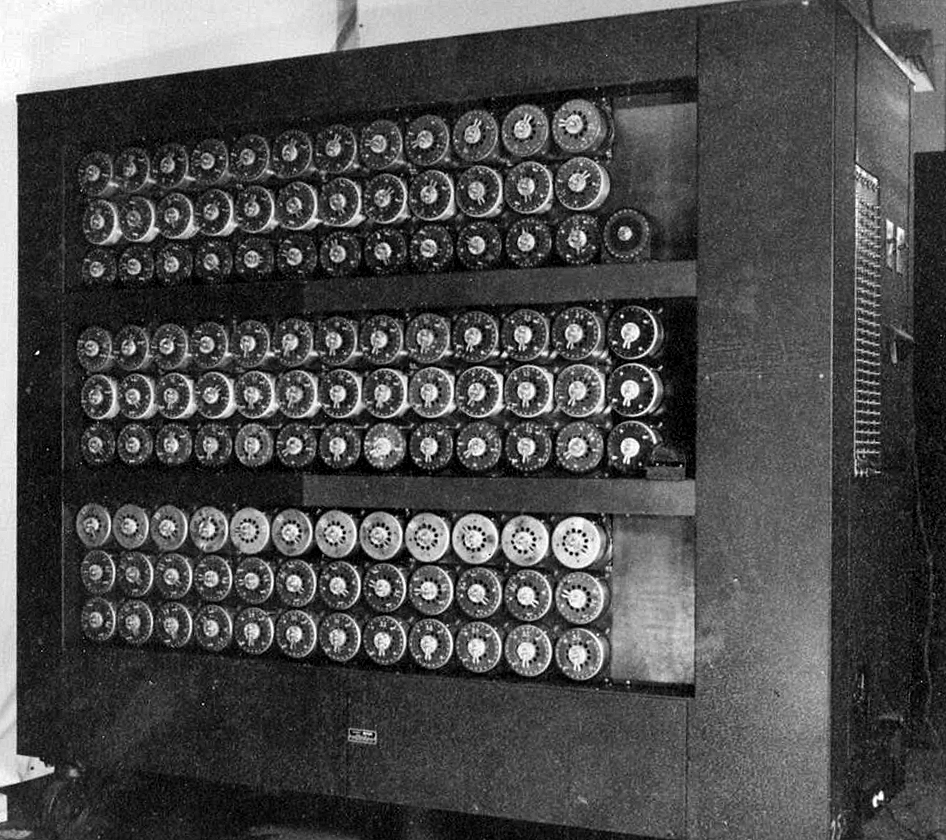
- During WWII, he helped figure out how to use machines (essentially, pre-computers) to crack what was previously unbreakable Nazi encryption. These involved the first somewhat programmable computers.
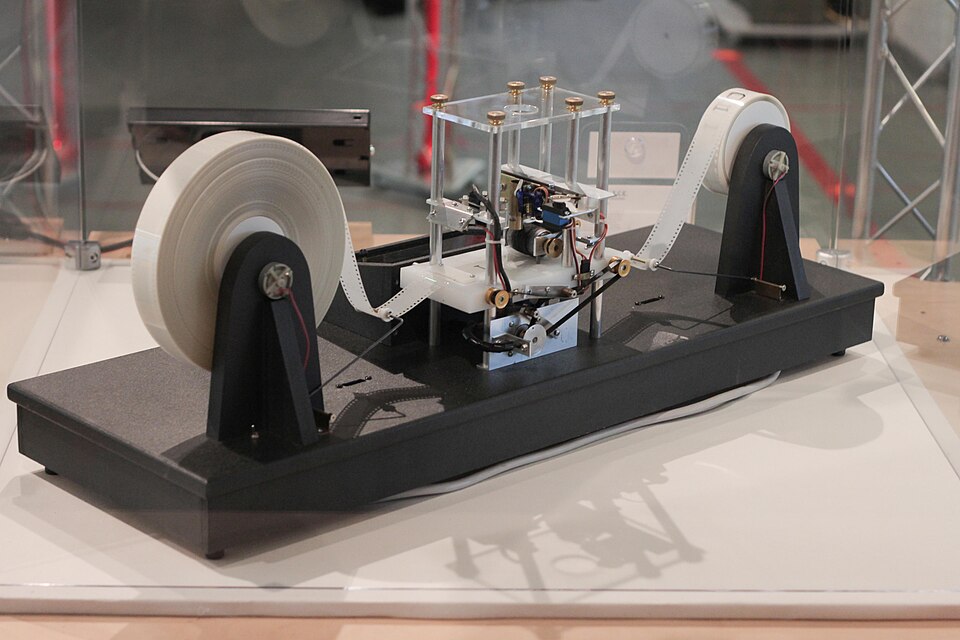
- Relevant to our class today, Turing also established fundamental results related to what can be expressed by a computer program. A model of computation he came up with, which involves an infinite tape and a machine in the middle that can read and write to the tape, is still used to model what we can express in computers. While this machine cannot be constructed (as the tape must be infinite in length), other models, including the topic of todays lecture, can be.
Persecution
Turing also, after WWII, was publicly prosecuted because he was gay and had no interest in hiding it.
As a result of the conviction for homosexuality, Turing was prevented from being involved in any further government work, which essentially cut him out of the ongoing development of computers. This was work that built upon both his theoretical contributions and his practical work during WWII. He was also denied entry to the US based on the conviction, and forced to undergo hormone treatment.
Just a few years later, at age 41, he took his own life.
It's worth reflecting on this, both to remember the ugliness that exists within our society, not so long ago, and to think about how much more a person like Turing may have done in a society that accepted him -- the astounding quantity he accomplished in essentially 20 years of work is such that the highest award in computer science is named after him. Who knows what he would have done if he had continued to work into the 60s and 70s, as computers expanded from massive and extremely limited government projects to powerful devices that began to resemble those we have today.
It's also a good reminder for us to reflect on how many people may have never entered the field -- we are so lucky that Turing did, and gave us these brilliant ideas, even if the high profile that it gave him ultimately led to such prosecution.
It's also important to remember these things aren't so distant in the past. Turing was only officially pardoned in England in 2013, and a law that pardoned men more generally who were convicted under laws banning homosexuality only passed in 2017.
Impossibility Results
The legacy that Turing gave us is incredible.
A fascinating example is that Turing proved what is now known as the Halting Problem, which was one of the first so-called impossibility results.
The Halting Problem (which he proved) says:
It is impossible to construct a program that, given another program as input, can determine whether or not the input program will run forever.
What is so interesting about that proof (and it parallels work by logician Kurt Gödel with other impossibility results) is that even while Turing and others were establishing the immense generality of this new idea of computation, they already were figuring out that computation itself had fundamental limits.
There were programs that were impossible to write. Not, difficult to write, or, we don't know how to write, but mathematically impossible.
Computation is Complex
Computation is, indeed, deep. From the same era -- 1937 -- mathematician Lothar Collatz presented this seemingly simple problem:
Is there an integer, when passed to the following function, that causes it to run forever?
def collatz(n: int) -> int:
    if n <= 1:
        return n
    elif n % 2 == 0:
        return collatz(n // 2)  # // divides, producing an int
    else:
        return collatz(n*3 + 1)
It's a simple program. You could have written it a couple weeks into this class. And yet, we are 88 years later and we still don't know. We've tried it on very large numbers (all of them up to 2.36×10^21), and all that we have tried it has terminated for, but still we have no idea if there might be some very large number for which it runs forever.
Act 2. Models of Computation
One central contribution that Turing gave was to create a universal model of computation, which is now called the Turing machine, which is a idealized model of a machine (it cannot be constructed in reality -- an approximation, where the tape is finite, is in a picture above) that is capable of expressing any program that can be expressed on any machine.
This is a deep idea on its own -- that anything that any computer could express could be expressed on this simple machine dreamed up in the 1930s (even if the particular machine cannot be constructed).
But, perhaps even more fascinating, that era involved many different universal models of computation, and one of Turings other results was showing that his Turing machine was equivalent to another -- the Lambda Calculus of his PhD advisor, Alonzo Church.
Moving towards the Lambda Calculus
The lambda calculus, unlike a Turing machine, can and has been used in real programs -- indeed, most languages can express it. It involves three things, all of which you have used in Python:
- lambda (anonymous functions) --
lambda ...: ... - variables (necessary for lambda, really) --
x,y, etc. - function application (to use the lambdas) --
f(x), etc.
And that's it. What Church and Turing showed was that with these three things, and nothing else, any program could be expressed.
Now, if you pause and reflect a little, this probably seems impossible.
Don't we need numbers, and strings, and booleans, and conditionals, and adding, and for loops, and recursion, and any number of other things that you've learned this semester?
The goal of today, and next class, is to show you that you don't. There may be practical reasons to have these in languages (they allow programs to run faster, as they allow what we write to be closer to what our machines actually run), but they do not allow us to write programs we could not write with just lambda, variables, and application.
This is a fascinating and fundamental result, and gets to the heart of the power and flexibility of computation.
Act 3. The Lambda Calculus
Let us begin.
Booleans: True, False, If
While we started class back in September with numbers, booleans are simpler data, so we begin our exploration of the lambda calculus with booleans.
We want to be able to write programs like:
True

True and False

if True:
    True
else:
    False

if not True or False:
    False
else:
    True
In order to do that, we need a way of expressing, using just our three tools (lambda, variables, application), True, False, and, or, not, and if.
If we focus on True and False, these are values. i.e., they don't evaluate. Our only value in the lambda calculus is... lambda (i.e., a function). So it must be that:
def TRUE(...):
    return ...

def FALSE(...):
    return ...
I write def TRUE and def FALSE here -- what I mean is that we are going to have a value (a function) that represents True and False. We won't have Python's True and False in our language, but we can use these particular functions to write programs that express boolean logic. i.e., all the examples above should be expressible with whatever choice we make.
Note that each def is just a convenient way of writing a lambda and giving it a name, so we can refer to it later. Python's own lambda can only contain a single expression, which makes longer lambda calculus programs hard to read, so we'll write all of our code with def. When we show, step by step, how a program runs, we'll write the functions with lambda, since at that point they have no names.
Clearly, these two values should be different (true is not false).
Since there are lots of different lambda functions, just picking two different ones probably isn't enough -- let's think about we will want to use them if, and see if that helps us narrow down what they should be. Specifically, we want to be able to express:
if COND:
    THEN
else:
    ELSE
Where COND, THEN, and ELSE are expressions -- COND should be a boolean (one of our lambda booleans! As in, whatever we choose to represent true and false, that, or a program that evaluates to that, will be here), THEN and ELSE can be arbitrary.
What if is doing, fundamentally, is using COND (our lambda calculus boolean) to decide whether to evaluate to THEN or to ELSE.
How can we possibly express this decision when all we have are lambdas, variables, and function application?
And what should our representation of true and false be, using lambda, anyway?
The answer to both of these questions ends up being the same:
A boolean is a function of two arguments that returns only one of them. Then the
TRUEversion can return one, and theFALSEversion can return the other. If we do this,ifcan work by applying the boolean it gets. Essentially, the boolean encodes the choice, rather thanif.
Let's make this concrete:
def TRUE(x, y):
    return x

def FALSE(x, y):
    return y

def IF(c, t, e):
    return c(t, e)
If we apply this to a concrete example, like one of the ones we wanted to be able to express:
if True:
    True
else:
    False
We can translate that to our lambda calculus representation as:
IF(TRUE, TRUE, FALSE)
Or, if we substitute for our constants:
(lambda c, t, e: c(t, e))(  # if
    lambda x, y: x,         # true
    lambda x, y: x,         # true
    lambda x, y: y          # false
)
If we run this, first we apply the IF lambda, substituting for the three arguments, yielding:
(lambda x, y: x)(  # true
    lambda x, y: x,  # true
    lambda x, y: y   # false
)
This is another application (of TRUE to TRUE and FALSE), so we now apply it -- in this case, the second argument is ignored, and the body is just the first argument, so the result is:
lambda x, y: x
Or, TRUE -- exactly as desired.
Reading programs written in the pure lambda calculus can be pretty tricky (like the example we just had).
For the rest of this lecture and the next, in order to make them easier to read, we'll use the named definitions we define for fragments of the lambda calculus that we want to re-use, and to the extent we can leave them as names, or do multiple steps at once, we'll do that. These definitions won't ever involve recursion, so they can always just be substituted (yielding programs that look like the above). This means we are still writing programs in the pure lambda calculus, but always using the names makes things a lot easier to read.
So for the above, we would write:
IF(TRUE, TRUE, FALSE)
And then would say that this steps to:
TRUE
Testing in Python
As we come up with more and more sophisticated encodings (a fancy word for what we just did with booleans -- figure out representations in the lambda calculus for true, false, and if), it will be more likely that we make mistakes. It will be really helpful to be able to actually run our examples -- indeed, part of the benefit of using the lambda calculus for this (instead of, e.g., a Turing Machine) is that what we are writing are real programs.
However, one issue is that since our results will always be functions (the only value we have), Python will just print these out as something like <function TRUE at 0x10b0e2340>, so we won't be able to tell if we what we got is what we wanted.
And functions, in Python (and many languages) cannot be usefully compared for equality: == only checks whether two functions are the very same function (as usually you wouldn't want to be checking that the actual code was equal, you'd want to know that the behavior was equal, but that'd require calling the two functions on potentially infinite arguments!).
One way around this is to add a little bit of code to convert back to ordinary Python values -- e.g., we can do this for our lambda calculus booleans (called Church Booleans after Alonzo Church) using the following function:
def tobool(cb):
    return cb(True, False)
If we call tobool(...) on one of our lambda calculus booleans, we will get back a normal Python boolean. This means we can, for example, take our previous example and wrap it appropriately, and write a test:
def test_if():
    assert tobool(IF(TRUE, TRUE, FALSE))
Clearly, tobool(..) is not a term in the lambda calculus (it includes Python's True and False). But, we'll only use this for testing, in order to read results, or, in some cases (e.g., for numbers), to be able to more easily construct example inputs (converting normal Python numbers into ones in the lambda calculus).
And, Or, Not
So we've figured out if, True, and False, but the true test of our representation is if we can also come up with lambda calculus representations of and, or, and not that work with out representations of True and False.
What does that mean?
Well, each should be a function -- and and or both take two booleans and return one boolean; not takes a boolean and returns a boolean.
So:
def AND(b1, b2):
    return ...
What should go in the ...? Well, if b1 is true (our representation of true!), then this function should return whatever b2 is (as if b2 is true, then b1 and b2 is true, and if b2 is false, then b1 and b2 is false). Whereas if b1 is false, then b1 and b2 is false no matter what b2 is.
So let's translate that into code, thinking about how TRUE and FALSE work.
If b1 is TRUE, we know it is a function that returns its first argument, so in that case. In that case, we would want AND to be:
def AND(b1, b2):
    return b1(b2, ...)
Since as we already figured out, if b1 is true, then we want to just return b2.
What should the second argument to b1 be? Well, if b1 is TRUE, it doesn't matter. But if b1 is FALSE, then it will ignore its first argument (so its fine if its b2) and will instead return whatever its second argument is. What do we want that to return? FALSE! So let's make AND be:
def AND(b1, b2):
    return b1(b2, FALSE)
or is similar -- except now if b1 is TRUE, we want to return TRUE, and if it is FALSE want to return whatever b2 is:
def OR(b1, b2):
    return b1(TRUE, b2)
For not, we have a single boolean argument, and if we get TRUE as input, want to return FALSE, and if we get FALSE, want to return TRUE.
How can we do that? Well, we know that TRUE will return its first argument, so:
def NOT(b):
    return b(FALSE, ...)
And if we get FALSE, then we know it will return its second argument, so we can complete as:
def NOT(b):
    return b(FALSE, TRUE)
So, we can express booleans. Let's move on to numbers -- specifically, we'll stick to natural numbers (0,1,2,...).
Numbers
Again we have task of representing values, this time things like:
0
1
2
3
...
1 + 2
3 * 4
...
Let's focus on the numbers. Again, they are values, so we need to figure out a way to represent them with lambda, i.e.:
def ZERO(...):
    return ...

def ONE(...):
    return ...

def TWO(...):
    return ...

...
And it should work for any natural number! How can we do that? One idea would be to have the number correspond to the number of arguments, i.e., 1 would be a one argument function 2 would be a two argument function (and whose body did...)... but since we can't create functions of dynamic number of arguments, it would seem to be impossible to implement something like +.
A better idea is to have each be a function with two arguments: a function and a value and have the function be applied a certain number of times to the value. Not in a row (since, until we implement mutation, running a function once and then running it again will produce the same result), but nested. i.e.,
def ZERO(f, x):
    return x

def ONE(f, x):
    return f(x)

def TWO(f, x):
    return f(f(x))

...
Now, clearly we can construct any natural number this way -- pick a number and nest the calls the right number of times.
We can even create a helper ofnum(..) that takes a Python natural number (an int that is 0 or more) and produces one of these (essentially -- it's not technically the exact same code, but it behaves the same way, and is extremely convenient for our understanding), and a corresponding tonum(..) that goes the other way:
def ofnum(n: int):
    def church_numeral(f, x):
        def r(m):
            if m == 0:
                return x
            else:
                return f(r(m - 1))
        return r(n)
    return church_numeral

def tonum(cn) -> int:
    def add1(y):
        return y + 1
    return cn(add1, 0)
Now, of course, in order for these to be useful, we need to be able to express + and * (and others!), so lets do that, starting with +.
Addition takes two numbers and returns one, so we can start with:
def ADD(n1, n2):
    return ...
Now, what should the result be? Well, we want a function lambda f, x: f(f(...f(x))) where there are n1 + n2 copies of f. Now, we know that n1 and n2 have this form already, but if we are going to be able to do anything with them, we have to apply them, so somehow it seems like we will need an f and x to pass to n1 or n2. So lets expand our solution to:
def ADD(n1, n2):  # ADD is a function taking two numbers
    def sum_of_n1_n2(f, x):  # Returning a number -- numbers are functions of f and x
        ...
    return sum_of_n1_n2
So how can we get the inner applications? Well, if we apply n1(f,x), this should give us back f(f(...f(x))) where there are n1 copies (where we interpret n1 as a number). If we want another n2 applications of f, we can pass this as the starting value (the x) to n2, and we get the following. We use local definitions to make it easier to understand, but like our other named definitions, we can substitute them -- so they aren't breaking our rules of only using lambdas, variables, and application.
def ADD(n1, n2):  # ADD is a function taking two numbers
    def sum_of_n1_n2(f, x):  # Returning a number -- numbers are functions of f and x
        n2_applied = n2(f, x)  # First we apply f n2 times to x
        n2_then_n1_applied = n1(f, n2_applied)  # Now we apply f n1 times to the prev result
        return n2_then_n1_applied  # And this is what we return
    return sum_of_n1_n2
How do we do multiplication? There are multiple ways of doing it, but one is noticing that n1 * n2 is the same as adding n2, n1 times, starting at 0. Note here that we are making particular choices for both f and x, knowing that our choice of f will be applied to our choice of x exactly n1 times. Like with ADD, we present this with local definitions to make it easier to read.
i.e.,:
def MUL(n1, n2):  # MUL is a function that takes two numbers
    def add_n2_to_y(y):  # We construct a function that adds n2 to its input
        return ADD(n2, y)
    add_n2_n1_times = n1(add_n2_to_y, ZERO)  # And then do that n1 times, starting with 0
    return add_n2_n1_times  # This is what we return
This would mean if we had 4 multiplied by 3, we get:
MUL(FOUR, THREE)  # -->
FOUR(lambda y: ADD(THREE, y), ZERO)  # -->
ADD(THREE, ADD(THREE, ADD(THREE, ADD(THREE, ZERO))))
To confirm, we can use our conversions:
def test_mul():
    assert tonum(MUL(ofnum(5), ofnum(6))) == 30
What about subtraction? Before we try to do n - m, let's do a simpler thing -- implement n - 1.
def MINUS1(n):
    return ...
Somehow, this has to take a function lambda f, x: f(f(...f(x))) and return lambda f, x: f(...f(x)) -- i.e., apply the function one fewer time.
How can we do that? Well, the easiest way to do it is actually to take a slight detour, to define our first structured data (which we can do, of course -- Church and Turing proved we can express everything) -- structured data with two values, which we'll call a pair.
Essentially, we want to define three things:
def PAIR(a, b):
    return ...

def FIRST(p):
    return ...

def SECOND(p):
    return ...
Where the ideas is that pairs are created with PAIR, and then one of the two values that was stored in the pair can be gotten out with FIRST or SECOND respectively.
How do we do that? Well, the idea is similar to how booleans work -- PAIR will create a lambda function, and then FIRST and SECOND will apply it in the right way (in this case by passing in functions that cause the right value to be passed back). Let's see:
def PAIR(a, b):
    def pair(z):
        return z(a, b)
    return pair

def FIRST(p):
    def first_of_two(a, b):
        return a
    return p(first_of_two)

def SECOND(p):
    def second_of_two(a, b):
        return b
    return p(second_of_two)
We can confirm this is working using some of our other helpers, i.e.,:
def test_pair():
    assert tonum(FIRST(PAIR(ofnum(10), ofnum(5)))) == 10
Why do we want pairs anyway? Well, the trouble with trying to subtract one is that, with church numerals, that amounts to applying a function one fewer time.
i.e., if the input is lambda f, x: f(f(f(x))), we want the output to be lambda f, x: f(f(x)).
A very clever idea (due to another logician working around the same time, Stephen Kleene) was to construct, at each step, a pair of the current step and the next step. Then getting the previous step amounts to extracting the first part of the pair.
Let's see:
def MINUS1(n):
    def one_less(f, x):
        def step(y):
            return PAIR(SECOND(y), f(SECOND(y)))
        return FIRST(n(step, PAIR(x, x)))
    return one_less
def test_minus1():
    assert tonum(MINUS1(ofnum(10))) == 9
Now we could implement general subtraction using the same strategy as we did for multiplication -- by repeatedly subtracting 1, but let's move on, to one last task we'd like to be able to do: check for equality.
As before, we'll start with a small problem -- just checking if a number is equal to 0.
def EQUAL0(n):
    return ...
How can we do that? Well, we want to return a boolean -- true if it is 0 and false in all other cases. In this case, we can use the fact that numbers are composed of f(f(...f(x))), i.e., if it is 0, then it is just whatever x is, and if it is non-zero, it is some number of applications of f:
def EQUAL0(n):
    def always_false(y):
        return FALSE
    return n(always_false, TRUE)

def test_equal0():
    assert tobool(EQUAL0(ZERO))
    assert not tobool(EQUAL0(ofnum(10)))
(We can get to general equality by combining generalized subtraction with EQUAL0, but we won't today).